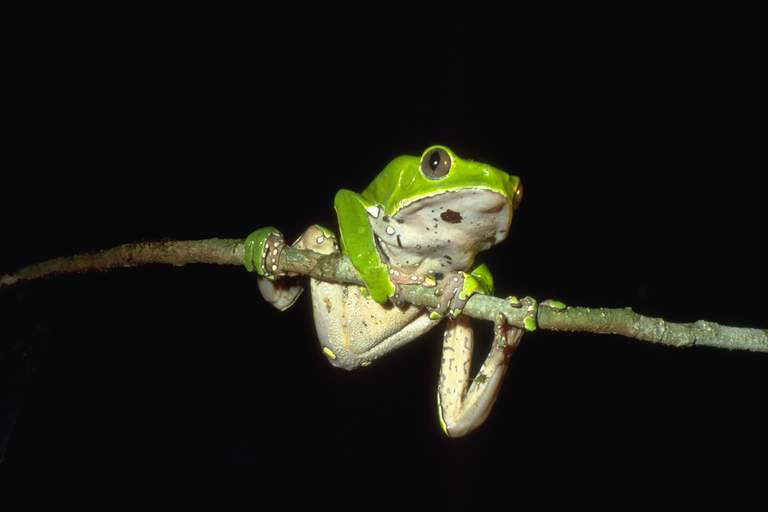
Large arboreal tree frog of the Amazon basin. The waxy skin secretion contains a remarkable peptide pharmacopeia — dermorphin and deltorphins (highly selective μ- and δ-opioid agonists), phyllocaerulein, sauvagine, and dozens of other bioactive peptides — collectively known in the practice as kambô or sapo.
Nocturnal canopy dweller in primary lowland rainforest along the Amazon basin. Calls during the rainy season from leaves overhanging water. The frog is not killed in the harvesting practice; the secretion is gently massaged from a stressed but unharmed animal.
The names this organism has been given by the cultures that have lived alongside it. Each carries an entire relationship — what is sacred is never simply translated.
- kambôPano · Katukina, Kaxinawá
- sapoSpanish loan · Matsés (Mayoruna)
- dow-kietMatsés
- Hunting tonic and panema (bad luck) cleanser among Matsés, Katukina, Yawanawá, and Kaxinawá peoples
- Applied to small skin burns; produces intense short-lived purgative reaction followed by extended sense of clarity and strength
Kambô is a physical practice rather than a psychedelic one — the acute experience is dominated by tachycardia, vasodilation, vomiting and bowel evacuation. Recent commercialisation outside its traditional context has raised real concerns about safety, sustainability, and respect for the originating cultures. Several deaths have been attributed to administration by undertrained Western facilitators.
- Erspamer 1989
- Daly 2000
- Aquila 2018


