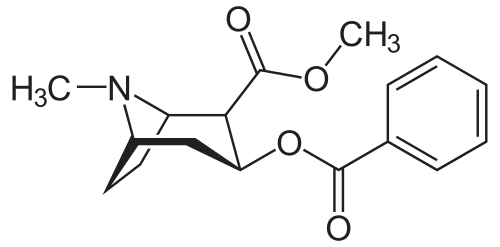
CN1C2CCC1C(C(C2)OC(=O)C3=CC=CC=C3)C(=O)OC The pharmacological targets through which this compound exerts its effects.
Living organisms in which this compound is naturally found.
- Plowman 1979
- Karch 2005
Tropane alkaloid of the coca leaf. Potent inhibitor of dopamine, norepinephrine, and serotonin reuptake, producing intense stimulation, euphoria, and local anaesthesia. Whole-leaf coca, with its many minor alkaloids and nutrients, has a profoundly milder profile than isolated cocaine.
Atoms positioned in their lowest-energy 3D geometry, sourced from PubChem. Drag to rotate · scroll to zoom · switch between stick, sphere, and line representations to feel the shape from different angles.
CN1C2CCC1C(C(C2)OC(=O)C3=CC=CC=C3)C(=O)OC The pharmacological targets through which this compound exerts its effects.
Living organisms in which this compound is naturally found.

Racemic tropane alkaloid of the deadly nightshade family — a competitive antagonist of muscarinic acetylcholine receptors that produces dilated pupils, dry mouth, racing heart, and (at higher doses) a deliriant state of fully formed, often disturbing hallucinations.

Pure L-isomer counterpart to atropine and substantially more potent at muscarinic receptors. The principal active tropane of henbane and a major component of belladonna, datura, and mandrake.

Tropane alkaloid found in Brugmansia, Datura, and other Solanaceae. Acts as a competitive muscarinic acetylcholine receptor antagonist, producing intense deliriant effects qualitatively distinct from classical psychedelics — including realistic hallucinations indistinguishable from reality.