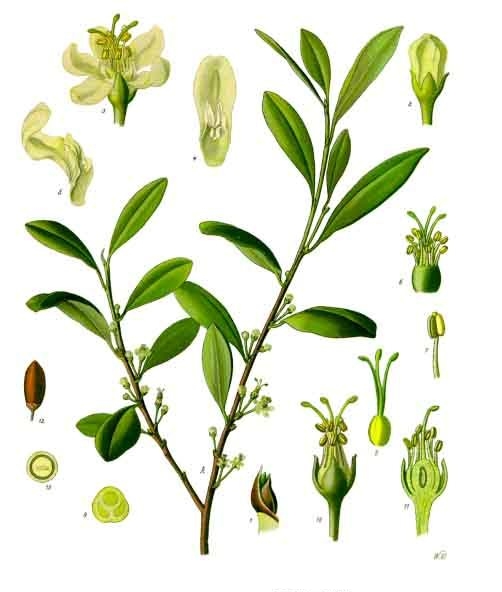
Andean shrub whose chewed leaves provide one of the world's most enduring stimulant traditions — sustaining high-altitude work, ritual, and medicine for at least 8000 years before its alkaloid cocaine was isolated and globally misused.
ECOLOGY & HABITAT
Cultivated on warm, humid Andean and Amazonian foothill slopes between roughly 500 and 2000 m.
Distribution
PeruBoliviaColombiaEcuador
INDIGENOUS NAMES
The names this organism has been given by the cultures that have lived alongside it. Each carries an entire relationship — what is sacred is never simply translated.
- KukaQuechua · Andean peoples
TRADITIONAL USE
- Ritual and daily use throughout the Andes — chewed with mineral lime ('llipta') or drunk as 'mate de coca'
CULTURAL CONTEXT
The whole leaf, with its many minor alkaloids, vitamins, and minerals, has a profoundly different pharmacological and cultural profile from isolated cocaine. The leaf remains sacred to many Quechua and Aymara peoples.
GALLERY
2 images
REFERENCES
Toggle scholarly mode in the footer for inline DOI links
- Plowman 1979
- Weil 1981


