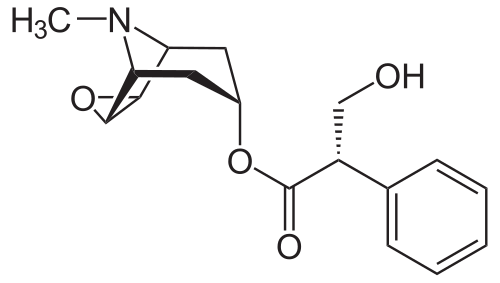
CN1[C@@H]2CC(C[C@H]1[C@H]3[C@@H]2O3)OC(=O)[C@H](CO)C4=CC=CC=C4 The pharmacological targets through which this compound exerts its effects.
Living organisms in which this compound is naturally found.

European perennial whose glossy black berries and dull-green leaves contain a lethal cocktail of tropane alkaloids — long associated with witchcraft, flying ointments, and Atropos, the Greek Fate who cuts the thread of life.

Tree with enormous fragrant pendulous flowers, containing the tropane alkaloids scopolamine, atropine, and hyoscyamine. Produces a deeply deliriant, dissociative state that many traditional practitioners describe as fundamentally different from — and more dangerous than — the tryptamine entheogens.

Cosmopolitan weedy annual whose spiny seed pods conceal an extremely dangerous mixture of tropane alkaloids — producing intense, fully formed hallucinations indistinguishable from reality, often followed by amnesia and lasting physical harm.

Sticky, foul-smelling Eurasian biennial whose dusky cream-and-purple flowers conceal high levels of hyoscyamine and scopolamine — an ingredient of pre-Christian European ritual, classical antiquity's Oracle at Delphi (per some scholars), and the witches' Sabbath of medieval folklore.

Rare, endemic tree of southern Chile's temperate rainforest, the only member of its genus. Contains scopolamine and hyoscyamine. Used historically by Mapuche machis (shamans) in southern Chile — feared and revered as a tree of madness, vision, and witchcraft.

Mediterranean perennial whose forked, vaguely human-shaped root has accumulated more folklore per gram than perhaps any plant in the European tradition — from the Hebrew Bible to Pythagoras, Pliny, and Harry Potter.

Mexican woody climber of the nightshade family with very large pale-yellow trumpet flowers. Contains the classic tropane alkaloids scopolamine and hyoscyamine at substantial concentration. Held sacred by the Huichol people, who call it kieli or kieri and treat it as a powerful, dangerous spirit.
- Schultes 1979
- Renner 1973


