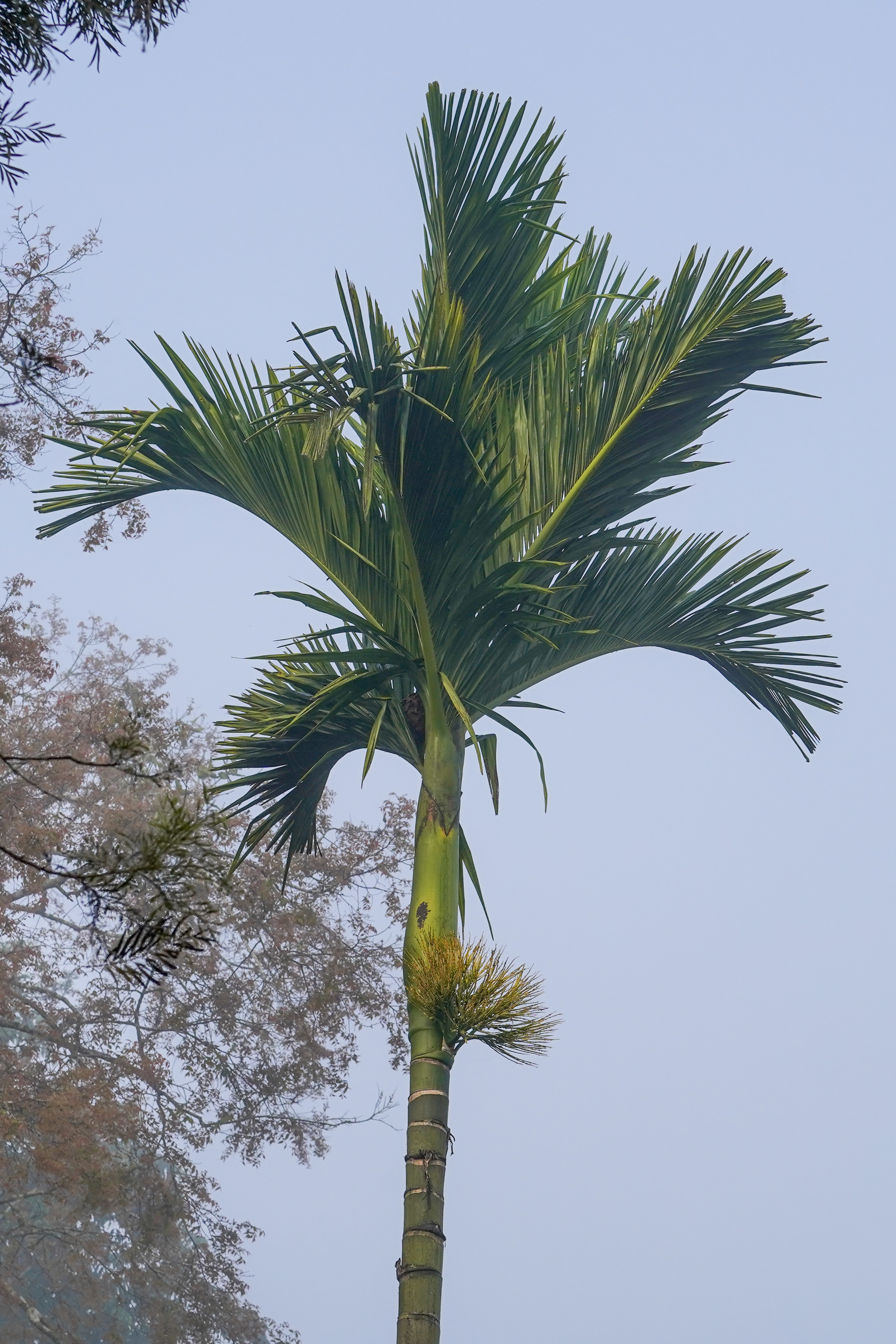
Slender tropical palm cultivated across South and Southeast Asia for its seed (the areca nut, commonly called the "betel nut"). The seed contains the alkaloid arecoline. Chewed in combination with betel leaf (Piper betle) and slaked lime by an estimated several hundred million people worldwide, making it the world's fourth-most-widely-used psychoactive substance.
Cultivated palm; rarely wild. Grows to ~20 m in humid tropical and subtropical climates with abundant rainfall.
The names this organism has been given by the cultures that have lived alongside it. Each carries an entire relationship — what is sacred is never simply translated.
- pinangMalay
- supariHindi
- puwakSinhala
- Daily social chewing across India, the Indonesian archipelago, the Philippines, Papua New Guinea, and much of the Pacific
- Offered to guests as a gesture of hospitality across South and Southeast Asia
- Central to marriage and other rite-of-passage ceremonies in many cultures
The WHO classifies areca nut as a Group 1 human carcinogen on the basis of strong oral-cancer risk with chronic chewing. The cultural and economic depth of the practice means it persists at very large scale despite this — a sobering example of a deeply rooted traditional psychoactive whose health profile we now understand much better than its originating cultures did.
- IARC 2004
- Gupta 2002


