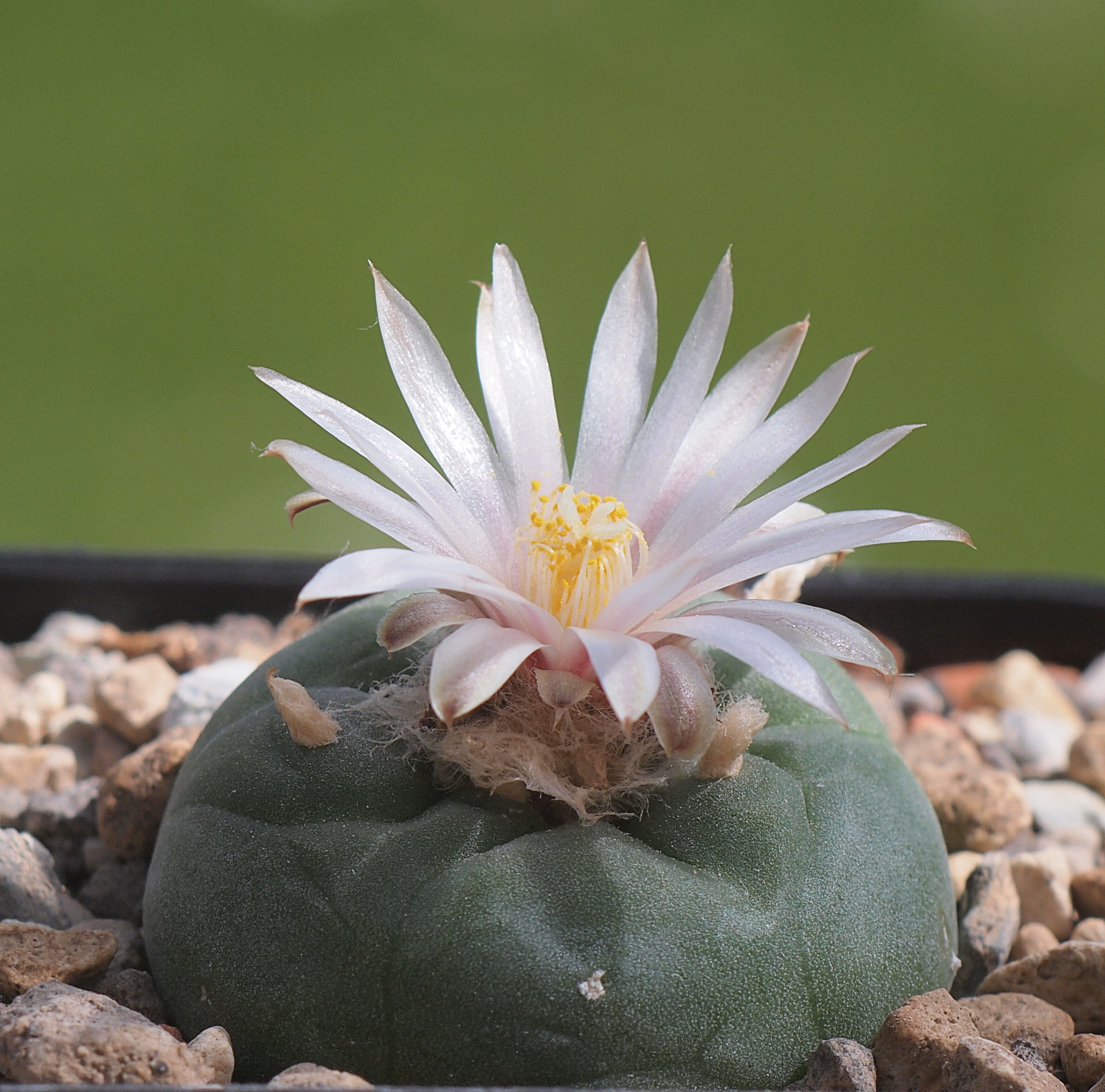
Close relative of true peyote (L. williamsii) but with a distinct alkaloid profile dominated by pellotine rather than mescaline — and a correspondingly sedative rather than visionary action. Endemic to a small area of Querétaro, Mexico.
Limestone outcrops in xeric scrub at ~1,000–1,400 m elevation in the Río Moctezuma valley of Querétaro.
The names this organism has been given by the cultures that have lived alongside it. Each carries an entire relationship — what is sacred is never simply translated.
- tsuwiriWixárika (Huichol)"false peyote"
- Distinguished by the Huichol as tsuwiri or "false peyote" — explicitly not the sacred plant, and said to mislead the unprepared
A useful reminder that the morphological similarity between Lophophora species masks substantial chemical differences. Wild L. diffusa is critically threatened — its tiny range and slow growth combined with collection pressure have driven a real conservation crisis.
- Bruhn 1976
- Anderson 1980


