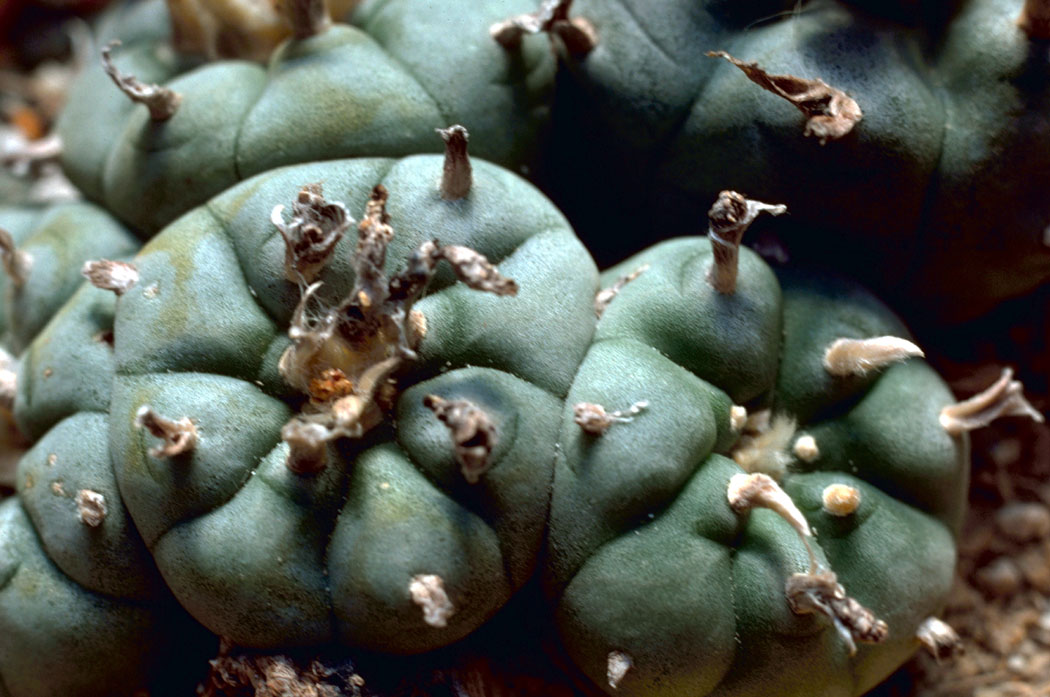
Slow-growing, spineless cactus containing mescaline. One of the most ancient and culturally significant entheogens of the Americas.
ECOLOGY & HABITAT
Grows in arid limestone soils of the Chihuahuan Desert.
Distribution
Mexico (Chihuahua, Coahuila, Tamaulipas)Southern Texas
INDIGENOUS NAMES
The names this organism has been given by the cultures that have lived alongside it. Each carries an entire relationship — what is sacred is never simply translated.
- PeyotlNahuatl · Aztec"Caterpillar cocoon (root sense)"
- Wíkuri / HíkuriWixárika · Huichol
- HikuliRarámuri · Tarahumara
TRADITIONAL USE
- Used for at least 5,000–7,000 years by indigenous peoples of Mexico and the United States
CULTURAL CONTEXT
Central to the Native American Church. Peyote is considered a sacred medicine and teacher, not a drug.
REFERENCES
Toggle scholarly mode in the footer for inline DOI links
- Schultes 1938
- Anderson 1996
- Native American Church


